Design
Infinity Pools on the Costa Blanca: What to Know
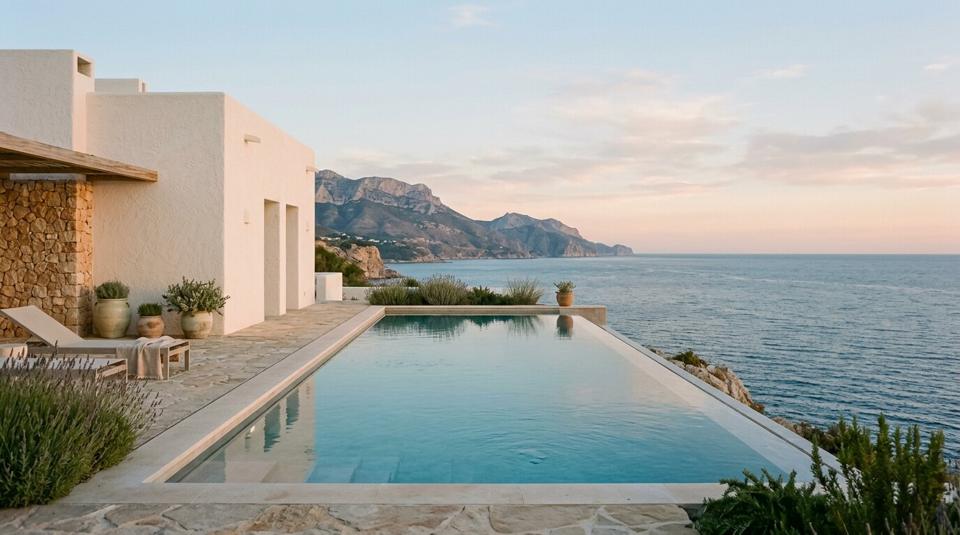
An infinity pool is not a style you add to a pool. It is a hydraulic and structural system that only pays off when the plot, the view and the architecture agree with each other. On the hillsides of Jávea, Moraira, Benissa and Altea that agreement is often possible — but it needs to be planned from the first sketch, not discovered on site.
What an infinity pool actually is
In an infinity (or vanishing-edge) pool, one or more walls are built slightly lower than the water level. Water flows continuously over that edge into a hidden channel or catch basin below, and is pumped back into the main pool. From the right viewpoint, the water surface appears to run straight into the sea or the sky beyond.
The effect depends on three things working together:
- A view worth extending — usually the sea, a bay or an open valley.
- A drop in level beyond the edge, so the catch basin is hidden from the main viewpoints.
- A precise, level weir, so the water sheet runs evenly along the whole length rather than in patches.
If one of these is missing, the result can look like an ordinary pool with an expensive overflow. A flat plot in an urbanisation with a neighbour's wall beyond is rarely the right place for one.
When it makes sense on the Costa Blanca
The northern Costa Blanca has some of the most suitable terrain in Spain for vanishing edges: steep, terraced plots with open views towards the Montgó, the Peñón de Ifach or the open Mediterranean. Many villas in Jávea, Moraira and the Altea Hills already sit on stepped retaining walls, which can make an infinity edge a natural extension of the existing architecture.
Before deciding, it helps to stand where you will actually look at the pool most often — the living room, the main terrace, the kitchen — and ask:
- Does the edge line up with the horizon, or will it cut across it at an awkward height?
- Is the view below the edge something you want to see (a garden slope) or hide (a road, a roof)?
- Is the edge visible from the house, or only from the far side of the garden?
A good designer will check these sightlines with sections and eye-level heights, not only with a plan. A difference of 30–40 cm in the pool level can change whether the water meets the sea or the hillside opposite.
The catch basin and balance tank
The water that spills over the edge has to go somewhere. It falls into a catch basin — a narrow channel along the base of the vanishing wall — or into a separate balance tank. This element is where most technical problems are either solved or created.
Why sizing matters
The basin must hold the water displaced by swimmers, the water in transit over the weir, and the water lost to evaporation and splash between top-ups. If it is too small, the pump can run dry when people get in and out, or the basin can overflow when the pump stops. A proper hydraulic design calculates this volume from the edge length, the flow rate over the weir and the expected bather load, rather than using a rule of thumb.
Pumps and running time
An infinity edge needs a circulation pump running whenever you want the effect. Many owners run the edge only in the hours they are using or looking at the pool, with the normal filtration cycle handling the rest. A variable-speed pump and an automatic level controller in the basin make this far easier to live with. Our guide to reducing pool energy consumption covers the running-cost side in more detail.
Structure, plot, licences and exposure
A vanishing wall is usually a cantilevered or partly elevated reinforced-concrete structure, often sitting on or beside a retaining wall. On a slope, this means the pool is not just a hole in the ground but a building element carrying significant water load. Expect the project to involve:
- A geotechnical study of the ground, particularly on fill, clay or fractured rock.
- Structural calculations signed by a qualified architect or engineer.
- Careful waterproofing of the weir wall and catch basin, which are more exposed to movement than a buried pool shell.
- A plan for access: many steep plots in Benissa or the Altea Hills cannot take large machinery, which affects excavation, concrete pumping and timescales.
New pools in the Alicante province normally require a municipal building licence — often a licencia de obra mayor or equivalent, depending on the town — and an infinity pool on a slope may also raise questions about setbacks from boundaries, height of retaining walls and visual impact. Rules vary between municipalities and sometimes between zones within one town. Our overview of building a pool in Spain explains the process in general terms.
Wind, evaporation and water
The same exposed positions that give the best views also catch the most wind. On the Costa Blanca, a sustained easterly (levante) or a dry westerly (poniente) can push the water sheet away from the edge, create splashing and increase evaporation. The falling water itself evaporates and cools faster than a still surface.
Practical responses include:
- Orienting the vanishing edge, where the view allows, away from the prevailing wind.
- Using a well-detailed weir profile that keeps the water sheet stable at moderate flow.
- Planning a cover for the main pool and running the edge only when needed.
- Considering water use carefully: some municipalities have applied summer restrictions on filling pools, and an automatic top-up system needs to work within local rules.
Hard, calcareous water is another local reality. Limescale tends to build up along the weir and the face of the vanishing wall, so finishes and pH control should be chosen with that in mind.
Design: aligning with the horizon
The most convincing infinity pools are restrained. The edge is straight, the coping is thin or absent on the vanishing side, and the interior colour is chosen to match the sea rather than to contrast with it. A few design points worth discussing with your architect:
- Interior colour. Mid-greys, sand tones and deep blues tend to read as part of the sea; very light finishes can look turquoise and artificial against the Mediterranean.
- Edge material. The weir needs a durable, precisely levelled finish — natural stone, porcelain or mosaic — detailed for constant water flow.
- Lighting. At night, the edge can disappear entirely. Soft lighting of the wall face or catch basin can keep the line readable without turning it into a feature.
- Safety. A vanishing edge above a drop needs a safe catch basin width and, on high walls, a considered solution for children and maintenance access.
For finish options and how they behave in local water, see choosing the right pool finish.
What drives the cost
Infinity pools are generally more expensive than conventional pools of the same size, sometimes considerably so. Publicly available market information for Spain in 2025–2026 suggests architect-designed villa pools with premium finishes, heating and terrace commonly start around €40,000–100,000+ (excluding IVA at 21%), with infinity pools on sloping plots generally above that range. These figures are indicative only; a real figure comes from a site visit and a detailed project budget.
The main cost drivers are:
- The structure: retaining walls, elevated walls and foundations on a slope.
- Site access and the need for smaller machinery, cranes or manual work.
- Length of the vanishing edge and the precision required on the weir.
- Catch basin or balance tank size, plus the extra pump and level controls.
- Finishes on the visible wall face, which on a hillside can be as prominent as the pool itself.
- Professional fees, studies and licence costs.
How Solmarea can help
Solmarea Pools designs and manages infinity pools on the Costa Blanca from the first site visit to the final handover. We study the plot, the views and the structure, design the edge and the balance tank, prepare a detailed budget and coordinate the architect, engineers, builders and installers involved. One team and one point of contact. If you are considering a vanishing edge, you can start your project with a short description and a few photos of the plot.