Renovation
How to Reduce Swimming Pool Energy Consumption
A typical villa pool on the Costa Blanca uses electricity in three main ways: the filtration pump, any heating, and lighting. In older installations the pump alone is often the largest single load in the house during summer. The good news is that most of the waste is in a few predictable places, and many of the fixes can be made without rebuilding the pool.
Where the energy goes
Before changing anything, it is worth understanding the pool's actual consumption. A single-speed pump of around 1 to 1.5 horsepower running eight to twelve hours a day in summer adds up quickly. An unmanaged heat pump on an uncovered pool can use far more. Lighting is usually smaller, but old halogen fittings — often 300 W each — are worth replacing.
A proper review of an existing installation typically looks at:
- Pump type, power rating and age.
- Daily running hours and when they happen.
- Filter size and condition, and pipework layout.
- Whether there is a cover, and how often it is used.
- Heating system, if any, and its control settings.
- Lighting type and number of fittings.
Variable-speed pumps
Replacing a single-speed pump with a variable-speed one is, for many pools, the most cost-effective energy measure available. The reason is physical: the power a pump draws falls sharply as its speed drops — in theory, roughly with the cube of the speed. Running a pump at half speed for twice as long moves the same volume of water while using a fraction of the energy.
In practice, savings depend on the pool, the pipework and how the pump is programmed, but manufacturers and independent tests commonly report substantial reductions in filtration energy compared with single-speed pumps. Variable-speed pumps are also much quieter at low speed, which matters on quiet residential plots.
A variable-speed pump only saves energy if it is set up properly. It should run at low speed for routine filtration, with higher speeds programmed only for tasks that need them: backwashing, running a robotic cleaner on a suction line, or feeding an infinity edge or water feature.
Filtration scheduling and electricity tariffs
A common rule of thumb in Spain is to filter for roughly half as many hours as the water temperature in degrees Celsius — around 13 hours at 26°C, fewer in cooler months. It is only a starting point: bather load, sun exposure, debris from trees and the type of sanitiser all affect what a particular pool needs. Many pools are over-filtered in spring and autumn simply because the timer was set in August and never changed.
When the pump runs also matters. Most domestic electricity contracts in Spain use time-of-use periods, with cheaper rates at night and at weekends and more expensive rates during weekday peaks. Shifting filtration to cheaper periods — or to daytime hours covered by solar panels, if you have them — can lower cost even when consumption stays the same. Some sanitising needs, such as salt electrolysis, work best with a share of filtration during daylight, so the schedule should be balanced rather than moved entirely to night.
Covers and heating
If the pool is heated, the cover is the most important energy measure of all. Most heat loss happens at the surface, through evaporation and radiation, and it is greatest on clear, windy nights. Covering the pool when it is not in use can significantly reduce how long the heat pump needs to run, as well as cutting water loss and the chemicals needed to treat top-up water.
Other heating measures worth considering:
- Choosing an inverter heat pump, which modulates its output instead of switching on and off.
- Setting a realistic target temperature; each extra degree has a noticeable cost.
- Heating only in the weeks you are actually there, with remote control to bring the pool up to temperature before arrival.
- Sheltering the pool from prevailing winds with planting or walls, where the design allows.
Our article on pool heating on the Costa Blanca covers heat pumps, solar and covers in more depth.
LED lighting, automation and solar PV
LED lighting
Replacing halogen pool lights with LED fittings typically reduces lighting consumption by a large margin, and LEDs last much longer. In many pools the new LED lamp fits the existing niche, which keeps the work relatively simple. Warm white tones usually suit natural stone and Mediterranean planting better than saturated colours.
Automation
A pool controller links the pump, heating, lighting, chlorinator and pH dosing, and allows them to be programmed and monitored, often from a phone. For holiday homes this is particularly useful: you can adjust filtration to the season, check water temperature and switch on heating before arrival, and receive alerts if something fails. Automation does not save energy by itself, but it makes it much easier to keep settings right over the year. The automation section of our modernisation page describes typical options.
Pairing the pool with solar PV
With high sunshine hours and a growing number of villas fitting photovoltaic systems, pairing pool loads with PV production is increasingly common on the Costa Blanca. Filtration and heat pumps can be scheduled to run mainly during daylight, using self-generated electricity. Some controllers can respond to surplus solar output automatically. If you are planning PV, mention the pool's equipment to the installer so the system can be sized and controlled with those loads in mind.
Hydraulic design: the hidden factor
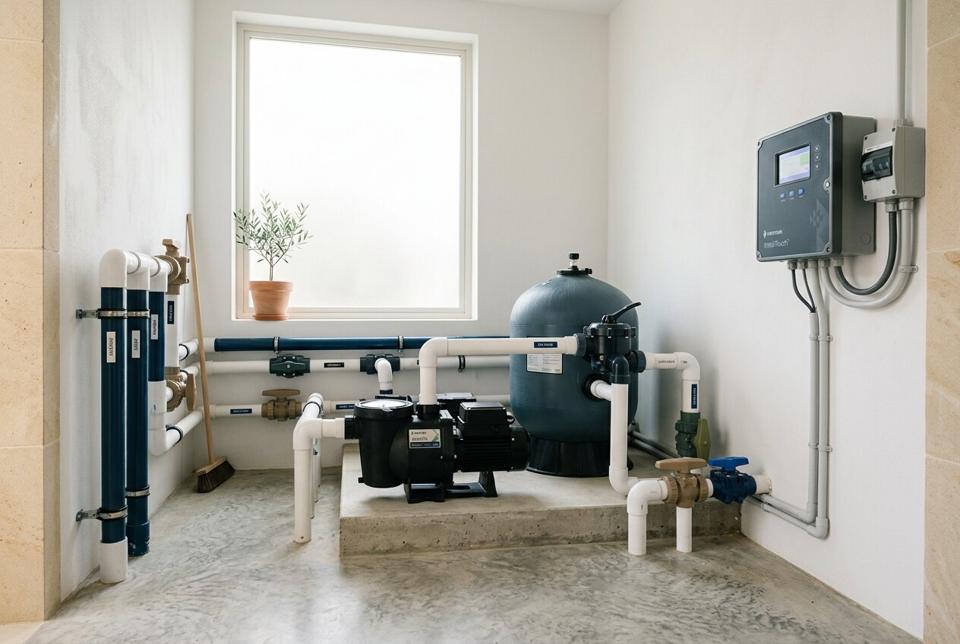
Pumps work harder when the water has to fight its way through the system. Undersized pipes, many tight bends, long runs to a distant plant room, a small or clogged filter and partially closed valves all increase resistance, and the pump uses more energy to deliver the same flow.
On a new pool, good hydraulic design is relatively inexpensive and pays back for decades: generous pipe diameters, short and direct runs, sweeping bends and a filter sized for the flow. On an existing pool, some improvements are possible without major work:
- Keeping the filter clean and backwashing according to pressure rather than habit.
- Replacing old sand with more efficient filter media where suitable.
- Correcting oversized pumps that were installed "to be safe".
- Checking for air leaks on the suction side, which reduce efficiency and can damage the pump.
Where to start, and how Solmarea can help
For most existing pools the order of priorities is fairly consistent: review running hours, fit a variable-speed pump, use a cover if the pool is heated, switch to LED, then consider automation and PV. Larger hydraulic changes are usually best combined with a wider renovation — see how to modernise an old swimming pool.
Solmarea Pools designs and manages pool upgrades on the Costa Blanca from the first inspection to the final handover: a review of your equipment, the measures worth making, a detailed budget, and coordination of the installers and electrical work involved. One team and one point of contact. To begin, start your project with a few details and photos of your pool and plant room.