Technical
Pool Heating on the Costa Blanca
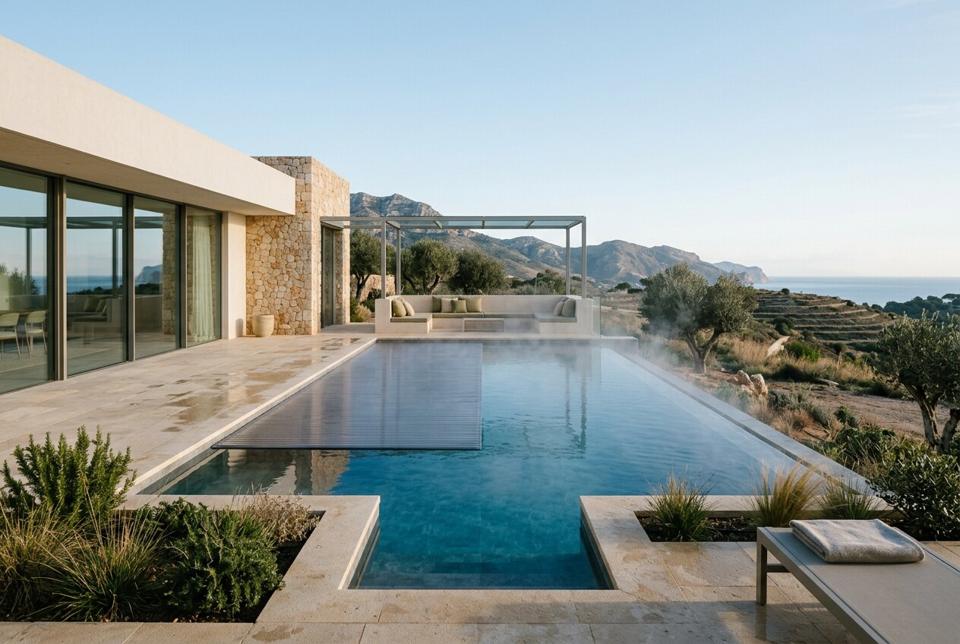
On the Costa Blanca an unheated pool is comfortable for roughly four months a year. With sensible heating, many owners swim from spring to late autumn, and some through most of the winter. The mild climate makes that achievable at reasonable running costs — provided the system is planned around the pool, the site and how you actually use it.
What heating actually changes
Sea and pool temperatures along the Costa Blanca typically peak in August and fall steadily from October. An unheated pool is generally pleasant from about June to September. A well-sized heating system combined with a cover can extend that to around eight to ten months, depending on orientation, wind exposure and the temperature you consider comfortable.
It helps to be specific about your goals before planning the installation:
- Which months do you want to swim, and at what water temperature (26°C feels very different from 29°C)?
- Is the house used year-round, or mostly at Easter, summer and autumn holidays?
- Do you need the pool warm on arrival, which affects how the system is controlled remotely?
Heating a pool for a two-week stay in April is a very different brief from keeping it at 28°C from March to November. The first may only need a heat pump switched on remotely a few days before arrival; the second calls for a correctly sized unit, a cover used every night and controls that adapt to the season. Being clear about this at the start avoids paying for capacity you will rarely use, or ending up with a system that cannot keep up in March.
Covers: the biggest lever
Most of the heat a pool loses goes through its surface — mainly by evaporation, especially on windy, dry nights. That is why a cover is usually the single most effective measure, before any heating equipment is chosen. A covered pool loses far less heat and water overnight, and the heater can then be smaller and run for fewer hours.
The main options are:
- Bubble (solar) covers — affordable and effective, but manual handling on a large pool is a daily chore, and they need storage when the pool is in use.
- Automatic slatted covers — rigid slats that roll out on a motorised drum, either above deck or hidden in a pit or wall. They are the most convenient and, with the right specification, add a layer of safety.
- Insulated winter covers — useful for longer absences, less so for daily use.
On a new pool, a submerged or recessed slatted cover can be integrated cleanly into the design. On an existing pool, above-deck systems or a bench-integrated drum are often possible. The covers section of our modernisation page describes what is usually involved.
Heat pumps and inverter technology
An air-source heat pump is by far the most common pool heating system on the Costa Blanca. It extracts heat from the outside air and transfers it to the pool water. Because local winter air temperatures are mild, heat pumps work efficiently here for most of the year.
Why inverter matters
Older on/off heat pumps run at full power until the target is reached, then stop. Inverter models modulate compressor and fan speed, running gently for longer once the pool is near temperature. The practical benefits are lower energy use over a season, quieter operation and less wear. For most new installations, inverter units are now the usual recommendation.
Sizing
Correct sizing depends on pool volume, surface area, whether there is a cover, wind exposure and the target season. An undersized unit struggles in early spring; an oversized one costs more than necessary. The project study should explain the assumptions behind the size proposed.
Indicative cost
Based on publicly available market information for 2025–2026, an inverter heat pump for a pool of around 40 m³ is commonly in the region of €3,500–4,500 installed in the Alicante area. This is indicative only; whether IVA (21%) is included should be stated in the budget, and electrical work, distance to the plant room and base preparation can change the figure. Only a site visit and a detailed project budget give a real price.
Solar thermal and other options
Solar thermal collectors — panels or mats through which pool water is pumped — use the sun directly and have very low running costs. They work well in summer and shoulder seasons but produce less heat in the shorter, cooler days of winter, which is exactly when heating is most wanted. They also need a large, well-oriented roof or ground area, often close to the pool, which can be hard to integrate discreetly on a villa.
Where solar thermal is used, it is often as a complement to a heat pump rather than a replacement: the collectors do most of the work in summer and the shoulder months, and the heat pump covers the gap in winter.
Gas boilers heat quickly but are now uncommon for private pools in the region because of running costs and emissions. Electric resistance heaters are generally only suitable for very small pools or spas.
| Option | Strengths | Limitations |
|---|---|---|
| Cover (any type) | Largest reduction in heat and water loss | Daily handling unless automatic |
| Inverter heat pump | Efficient in a mild climate, controllable, quiet at low speed | Needs space, airflow and electrical supply |
| Solar thermal | Very low running costs | Weak in winter, large collector area |
| Gas boiler | Fast heat-up | Running cost, emissions, fuel supply |
Noise and placement
A heat pump has a fan and a compressor, and on quiet hillside plots in Moraira or Altea the sound carries. Placement deserves as much thought as the choice of model:
- Keep the unit away from bedrooms — yours and your neighbours' — and from the main terrace.
- Allow free airflow; a unit boxed into a tight corner runs less efficiently and can recirculate its own cold air.
- Consider an acoustic enclosure or screen designed for the purpose, rather than an improvised one.
- Check local rules: some urbanisations and municipalities have noise ordinances or community rules on visible equipment.
- In coastal locations, a salt-air-resistant casing and coated coils help with durability. If the pool is or will be saltwater, a titanium heat exchanger is advisable.
Combining heating with solar PV
A heat pump runs mainly during the day, when the air is warmest and the pool is most exposed to the sun. That aligns well with photovoltaic production. If the villa has, or is planning, a PV installation, the heat pump and the filtration pump can be scheduled to use self-generated electricity, reducing grid consumption considerably. Some systems allow the heat pump to respond automatically to surplus solar production.
This works best when the pool equipment and the PV system are planned together, with compatible controls. See our guide to reducing pool energy consumption for how pumps, scheduling and automation fit in.
How Solmarea can help
Solmarea Pools designs and manages pool heating projects on the Costa Blanca from the first visit to the final handover: a realistic heating brief, correct sizing, a detailed budget, and coordination of the installers and electrical work involved. One team and one point of contact. To begin, start your project with the pool size, location and the months you would like to swim.