Technical
Saltwater vs Chlorine Pools
Many owners ask for a saltwater pool because they want to avoid chlorine. The honest answer is that a saltwater pool is a chlorine pool — it simply produces its own chlorine on site. The choice between the two is real and worth making carefully, but it is about comfort, routine and materials rather than chemistry-free swimming.
How salt electrolysis works
In a saltwater pool, a small amount of salt is dissolved in the water — typically in the region of 3 to 5 grams per litre, depending on the equipment. That is far less salty than the Mediterranean, which sits at roughly 37–38 grams per litre. Most people describe the water as soft rather than salty.
The water passes through an electrolysis cell (in Spain usually called a clorador salino). A low-voltage current splits the dissolved salt and produces hypochlorous acid and hypochlorite — the same active sanitiser you would get from adding chlorine tablets or liquid chlorine. Once that chlorine has done its job, it recombines into salt, so the salt level stays fairly stable and only needs topping up after backwashing, splash-out or dilution by rain.
In a conventional chlorine pool, the owner or maintenance company adds chlorine manually or through a dosing pump, typically as tablets, granules or liquid sodium hypochlorite. Some tablets also contain stabiliser (cyanuric acid), which can build up over a season.
Comfort and water feel
The strongest argument for salt is comfort, and it has a basis. Because the cell produces chlorine continuously in small amounts, levels tend to be steadier than with manual dosing, which often swings between high just after treatment and low a few days later. Much of the "chlorine smell" and eye irritation people associate with pools comes from chloramines — chlorine combined with sweat, sunscreen and other organic matter — and steadier sanitising can reduce those.
That said, a well-run chlorine pool with an automatic dosing system can also feel very comfortable. The difference is often less about salt itself and more about how consistently the water is managed.
pH control and hard water
This is the part that is often left out of sales brochures. Salt electrolysis tends to push pH upwards. On the Costa Blanca, where mains and well water are typically hard and calcareous, rising pH encourages limescale on tiles, on the waterline and inside the cell itself.
In practice, a salt chlorinator is best paired with:
- Automatic pH control — a probe and a small dosing pump that adds acid (usually a pH-minus product) to keep pH in the recommended range, often around 7.2–7.4.
- A self-cleaning cell with polarity reversal, which reduces scale build-up on the plates.
- Periodic checks of calcium hardness and alkalinity, not just chlorine and pH.
Without pH control, a saltwater pool in hard-water areas can need more attention than a conventional one, not less. Chlorine pools also need pH management, but liquid chlorine and many tablets affect pH differently, so the routine is not identical.
Corrosion, metals and natural stone
Salt at pool concentrations is mild, but over years it can affect materials around the pool — particularly in combination with coastal salt air, which most Costa Blanca properties already have.
Metals
- Ladders, handrails and fixings are generally better in marine-grade stainless steel (316 or higher) rather than 304.
- Heat pumps should have a titanium or other salt-resistant heat exchanger. Check this before converting a pool that already has heating.
- Older pumps, light niches and metal parts in the plant room may need checking for compatibility.
Natural stone
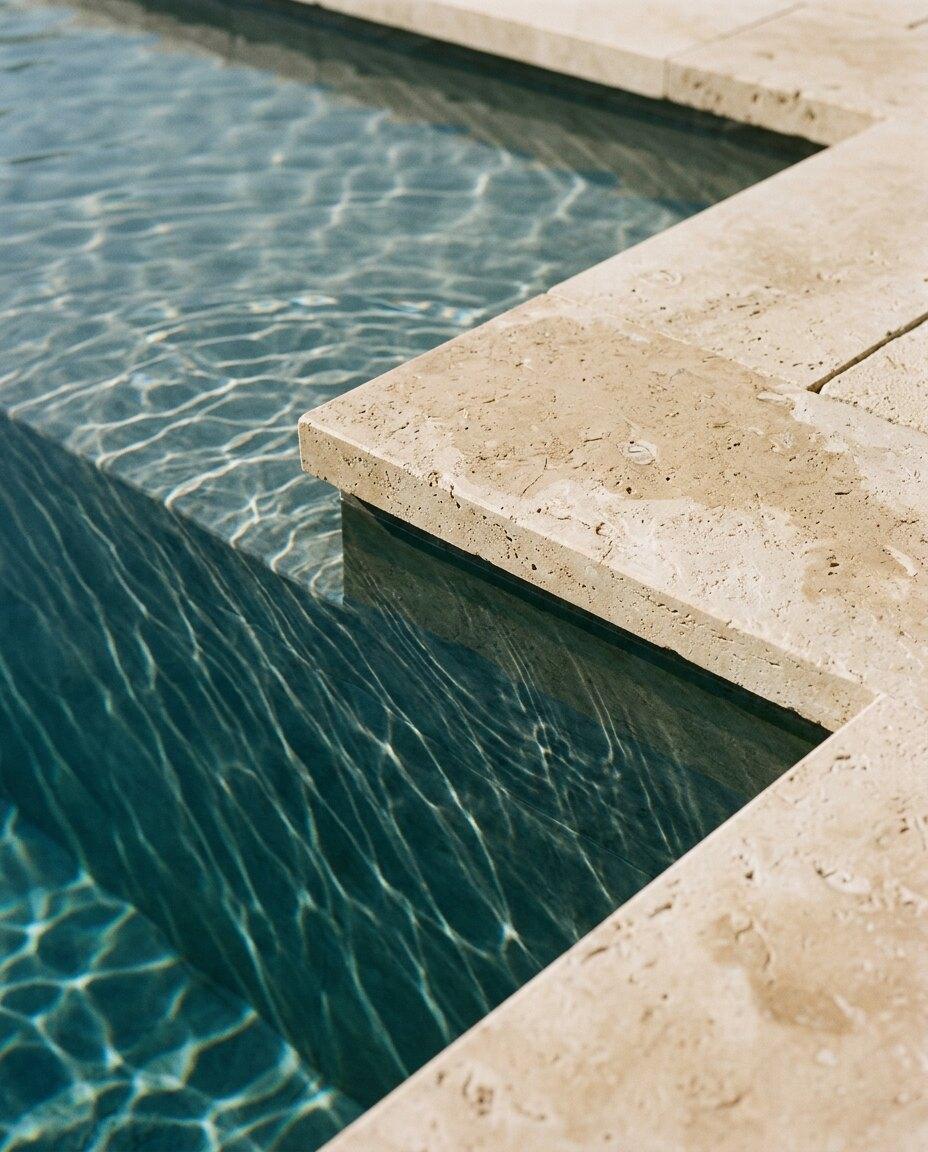
Some porous stones — certain limestones and sandstones used for coping and terraces — can be affected when salty water splashes, dries and leaves crystals in the pores. Over time this may cause surface spalling or efflorescence. Denser stones and good sealers reduce the risk, and regular rinsing of the coping helps. If you are planning a new terrace in natural stone, mention the pool's water treatment to the supplier; it is a relevant detail when choosing the material. See also choosing the right pool finish.
Side-by-side comparison
| Aspect | Salt electrolysis | Conventional chlorine |
|---|---|---|
| Sanitiser | Chlorine produced on site from salt | Chlorine added as tablets, granules or liquid |
| Chlorine stability | Steady, continuous production | Varies with dosing method; steadier with automatic dosing |
| pH tendency | Tends to rise; automatic pH control strongly advised | Depends on product; still needs regular correction |
| Upfront equipment | Higher: cell, control unit, often pH dosing | Lower, unless automatic dosing is added |
| Ongoing consumables | Salt top-ups, pH product, cell replacement every few years | Regular chlorine purchase, pH product |
| Materials | Check metals, heat exchanger and porous stone | Fewer salt-related concerns |
Cell life depends heavily on water hardness, running hours and maintenance, so manufacturers' figures should be treated as a guide rather than a promise.
Converting an existing pool
Converting a chlorine pool to salt is one of the more common modernisation steps on the Costa Blanca, and it is usually straightforward. A typical conversion involves:
- Checking the pool shell, finish, metals, heat exchanger and coping stone for salt compatibility.
- Balancing the water — pH, alkalinity, hardness — and, if stabiliser levels are high from years of tablets, partially renewing the water.
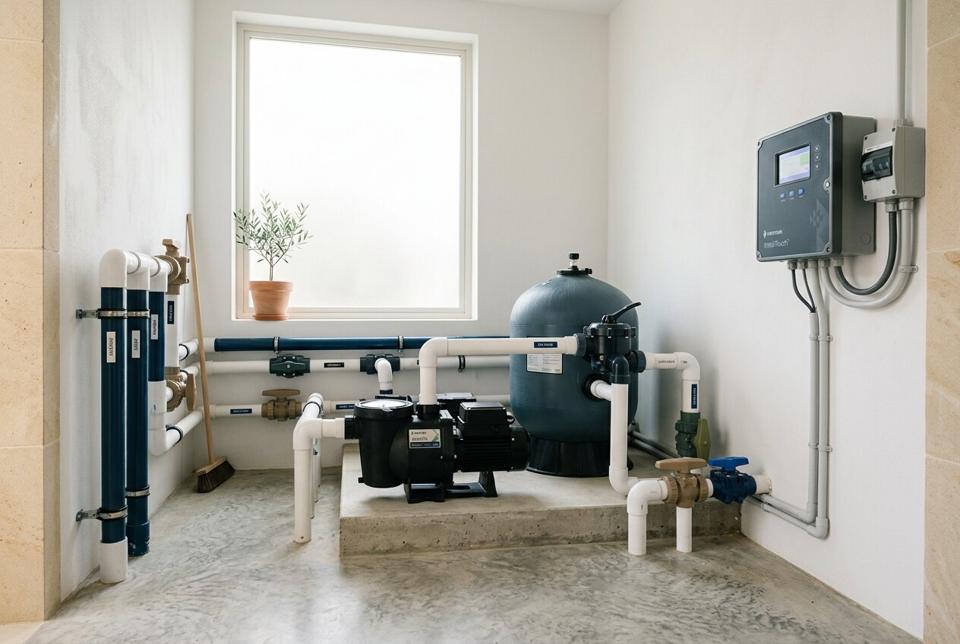
- Installing the electrolysis cell and control unit in the plant room, ideally with automatic pH control.
- Adding salt gradually to the level the equipment requires and letting it dissolve fully.
- Setting production according to pool volume, sun exposure and use.
Conversion is also a sensible moment to look at the rest of the plant room: an old single-speed pump, a tired filter or a manual valve setup. Our guide on how to modernise an old swimming pool covers that broader picture, and the saltwater section of our modernisation page outlines what is usually involved.
Which is right for you, and how Solmarea can help
Salt tends to suit owners who use the pool often, want steadier water and are willing to invest in pH control. Conventional chlorine with good automatic dosing can suit owners with porous stone around the pool, older metal equipment, or a pool used mainly in summer. For many holiday homes, the deciding factor is simply which system the maintenance company can manage reliably when you are not there.
Solmarea Pools designs and manages pool conversions and upgrades on the Costa Blanca from the first inspection to the final handover: a review of your pool and how you use it, a detailed budget, and coordination of the installation, from the chlorinator to pH control. One team and one point of contact. If you are considering a conversion, start your project with a few details and photos of the pool and plant room.